Basketball-first combo court
50 x 47 ft
Uses a real half-court basketball footprint and adds pickleball striping inside the surface where feasible.
Households that want legitimate half-court basketball first and pickleball as a secondary use.
Multi-sport planning
A multi-sport court is usually a compromise on purpose. The goal is not to satisfy every sport perfectly, but to choose the footprint that gives your household the best mix of pickleball, basketball, and general play on the lot you actually have.
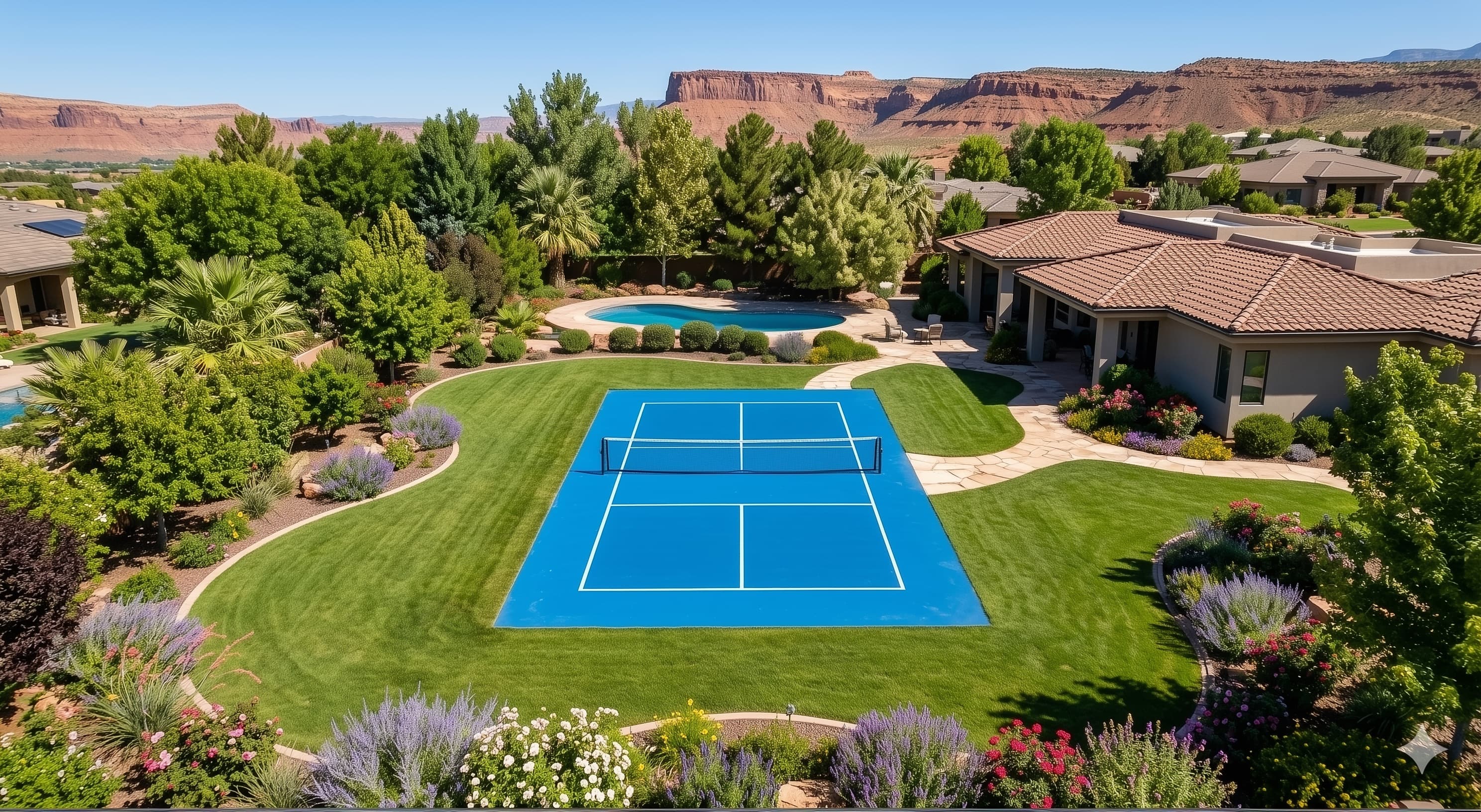
Basketball-first combo court
Uses a real half-court basketball footprint and adds pickleball striping inside the surface where feasible.
Households that want legitimate half-court basketball first and pickleball as a secondary use.
Pickleball-first flex court
Starts with a pickleball planning footprint and adds a hoop or casual basketball markings around the edges.
Smaller lots where pickleball is the main goal but a hoop and open hardscape still matter.
Tennis base with extra striping
Uses a full tennis-style footprint that can also support pickleball striping or other recreation uses.
Large properties where tennis remains part of the brief and the court is meant to serve multiple users over time.
What matters
Most residential multi-sport courts are built around one primary footprint, then striped or equipped to support a second use. In practice, that usually means a basketball-first half court with pickleball striping, a pickleball-sized court with a hoop for casual shooting, or a full tennis footprint that can also carry pickleball lines.
The right answer depends on what your household will use most. If competitive basketball matters, the basketball geometry usually drives the slab. If pickleball is the priority, a pickleball-first court with a hoop often makes more sense. If tennis remains in the mix, the lot generally needs to be large enough for a full tennis-style envelope before multi-sport striping is even worth considering.
Check your lot
Load your backyard in the planner, compare the realistic footprint against your actual lot, and keep the early sizing check tied to the property you already have.
We only use your address to load your property on the map.
Sizing authority
There is no governing body that publishes one universal backyard multi-sport court standard. In practice, multi-sport layouts borrow their baselines from the underlying sport authorities: USA Pickleball for pickleball court dimensions, USTA for tennis facility standards, and organizations such as the NBA for the full-court basketball reference used here. The combinations on this page are planning concepts built from those individual standards, not a separate official rulebook category.
Ready to verify your yard?
Run the same footprint against your lot lines, fences, patios, and open space before you move into installers, pricing, or design tradeoffs.
We only use your address to load your property on the map.
FAQ
It depends on the primary use. A basketball-first combo court often starts around a 50 x 47 foot half-court footprint, while a pickleball-first flex court is often closer to 30 x 60 feet or 34 x 64 feet. If tennis is part of the plan, the footprint usually needs to be much larger.
Yes, but only if you accept a clear priority. A basketball-first slab can support pickleball lines, and a pickleball-first slab can support a hoop, but one surface rarely delivers perfect competitive conditions for both sports at the same time.
Usually only on larger properties. Once tennis is part of the brief, the court envelope becomes much larger and often rules out a normal suburban backyard.